Passing Engineers’ Sensory Skills to the Next Generation
– Challenges in Civil Engineering × Technology –
Passing Engineers’ Sensory Skills
to the Next Generation
– Challenges in Civil Engineering × Technology –
Kansai University, Faculty of Environmental and Urban Engineering, Department of Civil and Environmental Engineering Prof. Takafumi Kitaoka
Research combining civil engineering with new technologiesProf. Kitaoka of Kansai University is working to solve challenges in the construction field by centering on civil engineering while flexibly incorporating cutting-edge technologies such as AI, data science, and haptic measurement.
His research themes are very broad and sometimes considered difficult to categorize, but at the core is a consistent perspective: “What can be done to ensure the success of civil engineering projects?”
By actively integrating technologies from different fields—such as urban planning education using games, AI analysis of ground data, and rock mass evaluation during mountain tunnel excavation—he is advancing research that reinterprets decisions traditionally reliant on human experience as data.
Capturing “rock mass evaluation,” traditionally based on experience and intuition, as data
 *Rock samples. From left: “smooth,” “grainy,” “rough.”
At construction sites such as tunnel excavation, accurately understanding the condition of rock masses is critical to the success of the entire project.
However, discrepancies often arise between pre-surveys and actual on-site evaluations, leading to delays and plan changes.
Prof. Kitaoka focuses on tactile sensations such as “rough,” “grainy,” and “smooth” that people feel when touching rock.
Experienced engineers can interpret a great deal of information through touch based on years of experience, but these judgments are tacit knowledge. Expressed only as onomatopoeia, they vary depending on the observer’s perception and are difficult to share in words or numerical values.
To address this issue, sensors attached to the fingers measure vibration and force, capturing tactile sensations as digital data. By combining this with AI analysis, the research explores the possibility of reproducing human-like judgment.
A new approach: tactile data × AI / Measuring human touch
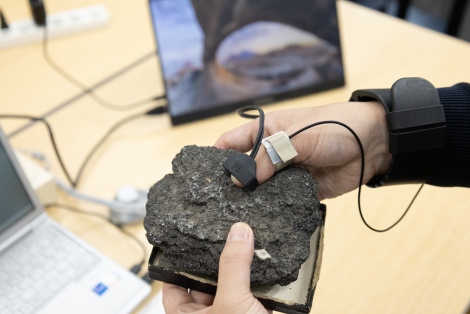
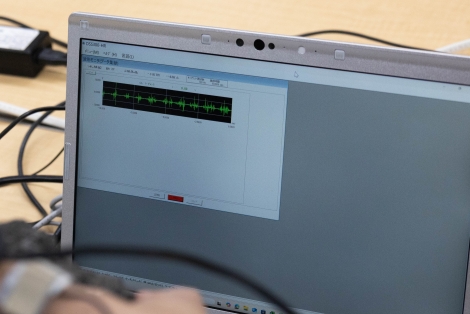
Until now, AI applications have mainly focused on visual and auditory data such as images and audio. In recent years, “multimodal AI,” which simultaneously handles multiple types of information including tactile data, has gained attention. In rock evaluation as well, research is progressing based on the idea that adding tactile data may enable judgments closer to human perception.
In experiments, rock samples that people consistently perceive as “rough” or “smooth” were selected, and the vibration waveforms and applied forces during touch were measured. Variations due to individual differences and touching methods are also being analyzed. By incorporating such variations and exceptions into learning, AI may approach human sensory perception.
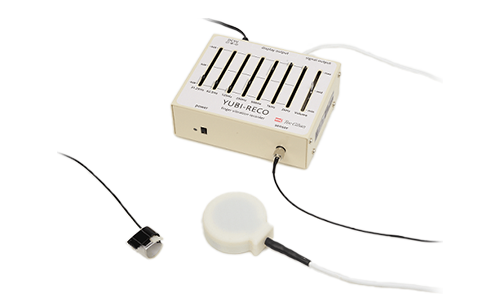
The finger-mounted recorder detects vibrations input to the fingertip using a piezoelectric film sensor wrapped around the finger, converting them into numerical data. In this study, vibrations generated when tracing rock samples were measured. Differences in vibration intensity and patterns can be observed for each type of rock.
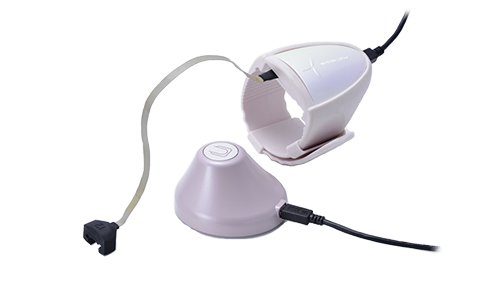
HapLog measures the pressing force of the finger when touching rock. The sensor is designed so that the fingertip pad remains exposed, ensuring that tactile sensation is not obstructed. Since the perceived pain varies depending on the roughness of the rock, differences in applied force can also be measured.
Correlations were observed between the outputs of these sensors and each onomatopoeic expression.
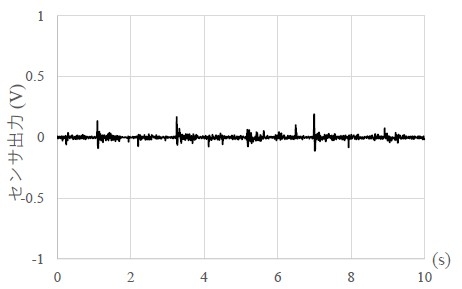 Smooth
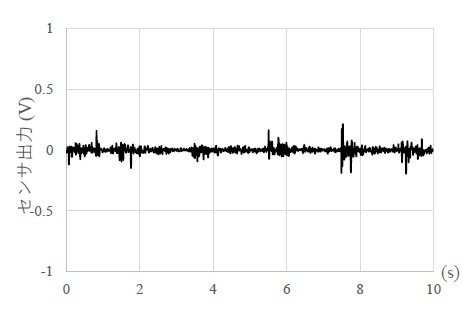 Grainy
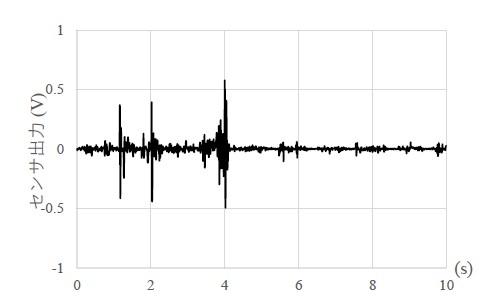 Rough
Rough
Ideas from the past becoming reality today
In fact, the concept itself has existed for over a decade.
At that time, there were attempts in which visually impaired individuals touched rock and evaluated the sensation. However, the technology to sufficiently measure and analyze tactile and auditory information was not yet available, and the idea remained a vision for the future.
Today, that vision is becoming reality.
With the miniaturization and increased precision of sensors, along with advances in AI technology, it is now possible to capture and analyze vibrations and applied forces when humans touch objects. Long-conceived ideas are finally taking shape as practical research.
By connecting past concepts with current technology, new possibilities are emerging for passing on the “craftsman’s intuition,” previously treated as tacit knowledge, to the next generation.
Addressing skill transfer and labor shortages in the construction industry
In the construction industry, the decline of skilled engineers due to an aging population and low birthrate has become a serious issue.
Opportunities for younger workers to gain on-site experience are limited, and safety concerns often keep them away from hazardous tasks, reducing opportunities to build experience.
By utilizing measurement data including tactile information, it becomes possible to record how experienced engineers apply force and make judgments.
This has the potential to lead to new forms of skill transfer that can be applied to education and training.
The future of civil engineering × data: connecting human senses and technology
In this research, vibration and force measurement using compact sensors attached to the fingertips play a crucial role.
The ability to acquire data in a natural state without interfering with the act of “touching” is a significant advantage.
Prof. Kitaoka plans to further advance analysis by combining tactile data with visual and auditory data, as well as enhancing AI-based rock evaluation.
Through these efforts, capturing human sensory perception as data and applying it to on-site decision-making and skill transfer is expected to become an important element supporting the future of the construction industry, including applications in physical AI.
Related Products